

Art in Edinburgh is striking in its diversity. The main reason for this is undoubtedly the large number of talented figures there. They are the ones who advance culture and contribute to its continuous development. More at edinburghski.
Representatives from various fields—music, theatre, sculpture, and, of course, painting—strive to make art more interesting for the public. They also improve it by introducing new techniques, styles, and genres.
Undoubtedly, contemporary artists aim for this state of affairs. Their colleagues, who worked many years ago, also constantly refined their respective fields, creating genuine masterpieces.
Of course, perfection does not exist in the world. No matter how hard you try, there is always room to grow. When it comes to painting, this field demands enormous effort. To master this art, it is vital to learn various techniques, study historical information, and continually work on oneself.
Andrew Wilson is one of the most famous Scottish landscape painters. This artist’s works are immediately recognizable from others. He possesses a distinctive authorial style, which undoubtedly enhances the appreciation of his paintings.
Training and Trip to Italy
Andrew was born in Edinburgh in 1780. From an early age, the boy began studying art. His teacher was the famous artist Alexander Nasmyth.
When the young man turned 17, he travelled to London, where he worked for a time in the schools of The Royal Academy of Arts.
However, Wilson understood that he still had much to learn as an artist. Therefore, in 1800, he decided to travel to Italy, where he dedicated himself to studying the works of talented masters, focusing on their styles and techniques. This period also allowed Andrew to create numerous sketches, mainly depicting the architectural structures of the Roman and Neapolitan environs.
How Napoleon Valued the Artist’s Work
The artist returned to London in 1803, but only briefly. He soon set off for Italy again. However, Europe was gripped by war at the time. Nevertheless, Andrew managed to reach Genoa, where he was fortunate enough to find protection from the American Consul. Wilson also became a member of The Ligurian Academy.
As a member of this society, Andrew was involved in a very interesting event. He was present during a visit by Napoleon Bonaparte to one of the exhibitions. When a jealous rival pointed to Wilson’s painting and informed the French Emperor that it was the work of an Englishman, the reply was conclusive: “Talent knows no bounds.”
Importing Paintings
It should be noted that it was during his Italian period that Andrew saw the advantage of importing Old Master paintings to London. Thus, in 1805, he returned, bringing with him over fifty canvases.
Further Development of His Career
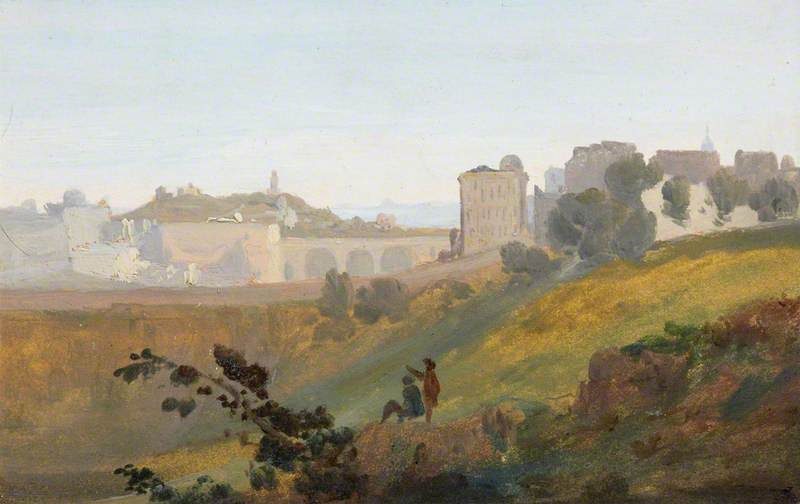
However, Wilson’s life later developed in such a way that he did not return to Italy again, settling permanently in London. There, he devoted himself to creating watercolour works. He became one of the first members of The Associated Artists community and also took up the position of Drawing Master at The Royal Military College.
In 1818, Andrew received a new appointment. He was made Head of The Trustees’ Academy, an art school in Edinburgh where one could obtain a higher education in the field of art.
A Huge Surprise and Return to Italy
The year 1826 marked a stroke of luck for Wilson. He received a significant sum of money from Peter Spalding as recognition for his work in the landscaping of Queen Street Gardens in Edinburgh.
This came as a huge surprise to Andrew. Subsequently, using these funds, he and his family returned to Italy. From 1826 onwards, he lived in Genoa, Rome, and Florence for the next twenty years.
But it is important to note that art remained the focus of the painter’s life. A significant part of his daily routine involved consulting on art matters. He also collected paintings for private collections and, of course, created many works using oil paints and watercolour.
Sudden Death
Interestingly, life ultimately played a cruel joke on Wilson, particularly concerning his constant travels.
In 1847, he left his family in Italy and decided to travel to Scotland again. Everything seemed fine. Having finished his business, Andrew was preparing for the return journey. But just before his planned departure, he suddenly died in Edinburgh.
This happened on 27 November 1848.
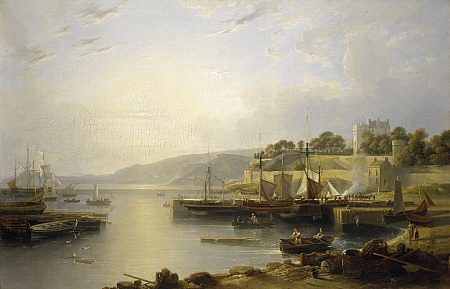
Thus, Andrew Wilson established himself as one of the most famous landscape painters. Possessing a distinct style and dedicating his life to art, this master created unique canvases. He also played an important role in establishing many private collections for notable figures.
For almost his entire life, the artist travelled between Italy and his homeland. But one of those trips ended in sorrow. His sudden death seemed to be an unspoken fate: that the talent born in Edinburgh must one day remain there forever…